A leather luggage tag is a small thing that does one important job at the worst possible moment: it tells an airport who a lost bag belongs to and how to reach them. It is easy to over-design the leather and under-think the contents. Getting the information right, and knowing what to deliberately leave off, is what separates a tag that recovers your bag from one that just looks nice on the belt. Here is how to decide what goes on it.
Most “lost” bags are not lost
The reassuring truth behind mishandled baggage is that the vast majority of bags are only delayed and then reunited with their owner. Across roughly five billion passenger journeys in 2025, about 24 million bags were mishandled, which is on the order of five bags per thousand travelers, and each one costs the industry an average of around 260 dollars to sort out. Of those mishandled bags, the large majority are simply delayed rather than damaged or gone for good, as the breakdown below shows.
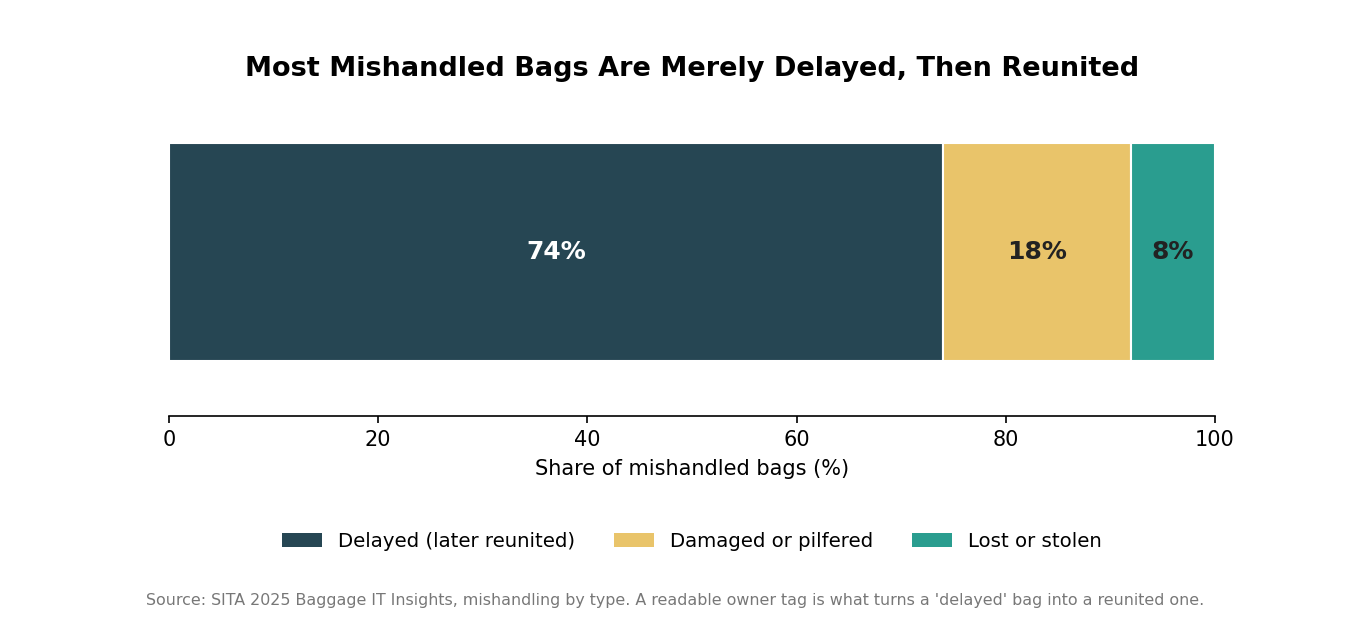
That single fact should shape your tag. When a bag is delayed, an airport or airline needs to match it to a person and contact them quickly, often in a city or country neither of you planned on. A clear, current owner tag is the mechanism that turns a delayed bag into a reunited one. A blank or unreadable tag turns the same bag into an unclaimed item in a warehouse.
The three things to put on it
Keep the front of the tag to the essentials, because clarity beats quantity when a handler is scanning hundreds of bags. The first line is your full name as it appears on your ticket, so the tag matches the passenger record the airline is searching. The second is a mobile phone number with the country code, written in full international format such as a plus sign and country code, since the person calling may be dialing from abroad. The third, optional but useful for international trips, is an email address, which works across time zones when a phone call will not. Three short lines, cleanly laid out and comfortably readable at arm’s length, is the whole job.
Legibility is a design decision, not a detail. Handlers read tags quickly and often in poor light, so favor a clear typeface at a generous size over a small decorative script, and leave enough contrast between the ink or impression and the leather that the text does not disappear into a dark hide. If you want a modern backup, a small QR code that points to a contact page or an “if found” message can sit alongside the printed lines, but it should supplement human-readable text rather than replace it, because not every handler will stop to scan.
What to leave off
This is where good intentions cause problems. Do not put your home address on the outside of a tag. A bag tag announces that you are traveling, and pairing that with a street address effectively advertises an empty house to anyone who reads it in a terminal. Leave off hotel names and room numbers for the same reason, and because your itinerary changes. And never put passport numbers, national ID numbers, or frequent-flyer numbers on an exposed tag, since those are exactly the identifiers used for identity theft and they do nothing to help a handler return a bag. If you want an address on the bag at all, put a work address or a simple city, and keep the sensitive details on a card tucked inside.
Design for the transfer, not the direct flight
Where bags actually go wrong tells you how to design the tag. The single largest cause of mishandling is transfers between flights, which alone accounts for around 41 percent of cases, followed by bags that fail to load and a cluster of ticketing and tagging errors.
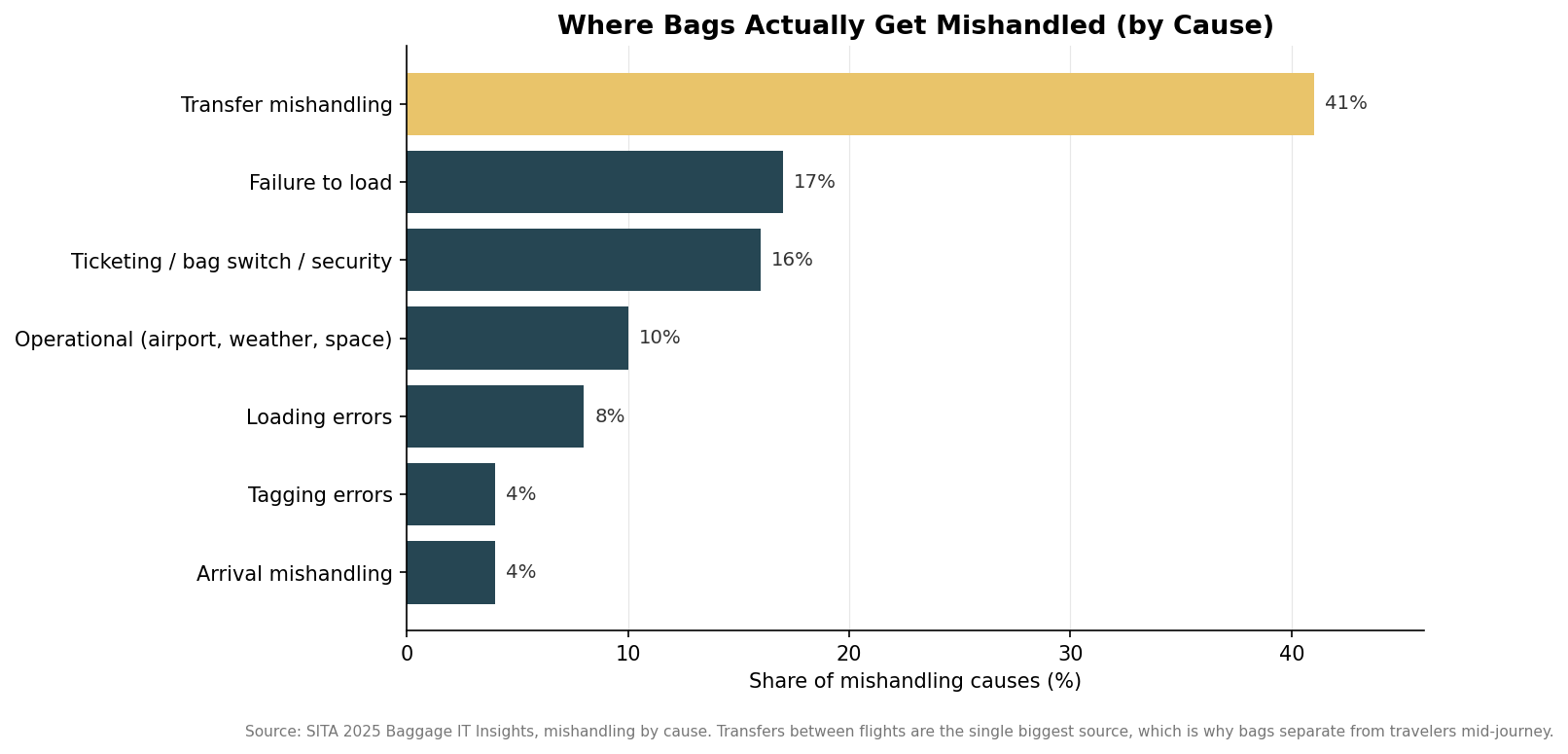
The practical meaning is that your bag most often separates from you in the middle of a journey, in a connecting airport where the staff handling it may not share your language and are working from whatever is legible on the tag. That argues for international phone formatting, for an email as a language-neutral backup, and against clever layouts where the contact details are decorative rather than obvious. It also argues for a second identical tag or an ID card inside the bag, because outside tags do get torn off on the belt, and the inside label is what the airline finds when they open an unclaimed bag to identify it.
Make it survive the belt
Leather earns its place here because it takes abuse better than paper inserts and flimsy plastic sleeves, but the marking method still matters. A debossed or embossed impression, or a laser-etched mark, is part of the leather itself and stays readable after months of scuffing, whereas a printed paper insert behind a window fades, smears, and slides out. If you use a window-and-card tag, treat the card as replaceable and check it before each trip. On the privacy question of covered versus open tags, a flap or covered design hides your details from a casual glance in the terminal while still being readable when a handler lifts it, which is a reasonable middle ground; an open tag is faster to read but exposes everything all the time. Whichever you choose, write the details in permanent ink or, better, have them marked into the leather, and make sure the strap and its fastener are strong enough that the tag is still attached when the bag comes around the carousel. The best tag is the one that is still there, still legible, and still current when someone finally needs to read it.
If you are ordering a batch
Much of what gets bought is not a single tag but a run of them, for a team, an event, or a client gift, and the same principles scale with one addition. Decide up front whether every tag carries the same detail or whether each is personalized with an individual name, because variable personalization changes how the artwork is set up and can affect lead time. A common and privacy-safe approach for corporate gifts is to deboss the brand or a name on the front and leave the contact lines to the recipient, either on a replaceable insert card or in a space they can fill in themselves, so you are not printing anyone’s personal phone number across a whole order. Whatever you choose, order one physical proof and check the marking depth and legibility on the actual leather before committing to the full quantity, since a mark that looks sharp on screen can read faint once it is pressed into a textured hide.