Category: Uncategorized

  • What to Put on a Leather Luggage Tag (and What to Leave Off)

    What to Put on a Leather Luggage Tag (and What to Leave Off)

    A leather luggage tag is a small thing that does one important job at the worst possible moment: it tells an airport who a lost bag belongs to and how to reach them. It is easy to over-design the leather and under-think the contents. Getting the information right, and knowing what to deliberately leave off, is what separates a tag that recovers your bag from one that just looks nice on the belt. Here is how to decide what goes on it.

    Most “lost” bags are not lost

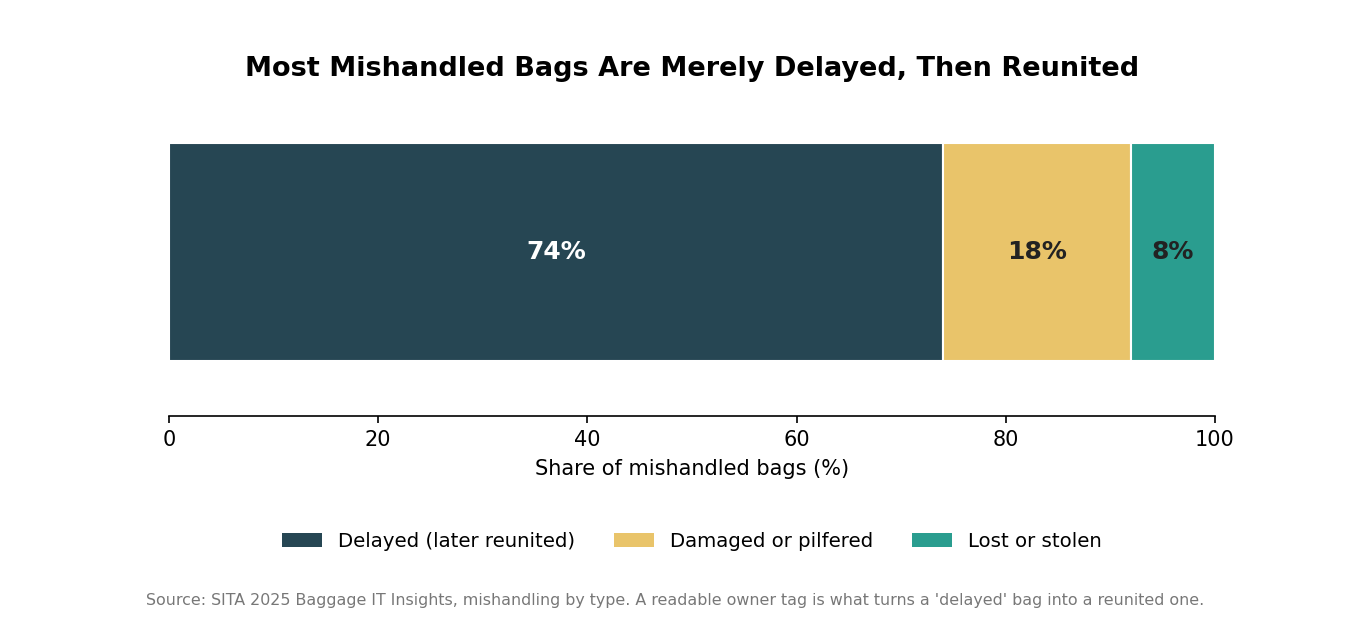
    The reassuring truth behind mishandled baggage is that the vast majority of bags are only delayed and then reunited with their owner. Across roughly five billion passenger journeys in 2025, about 24 million bags were mishandled, which is on the order of five bags per thousand travelers, and each one costs the industry an average of around 260 dollars to sort out. Of those mishandled bags, the large majority are simply delayed rather than damaged or gone for good, as the breakdown below shows.
    Stacked bar showing 74 percent of mishandled bags are delayed, 18 percent damaged or pilfered, 8 percent lost or stolen
    Most mishandled bags are only delayed, which is why a legible owner tag matters.

    That single fact should shape your tag. When a bag is delayed, an airport or airline needs to match it to a person and contact them quickly, often in a city or country neither of you planned on. A clear, current owner tag is the mechanism that turns a delayed bag into a reunited one. A blank or unreadable tag turns the same bag into an unclaimed item in a warehouse.

    The three things to put on it

    Keep the front of the tag to the essentials, because clarity beats quantity when a handler is scanning hundreds of bags. The first line is your full name as it appears on your ticket, so the tag matches the passenger record the airline is searching. The second is a mobile phone number with the country code, written in full international format such as a plus sign and country code, since the person calling may be dialing from abroad. The third, optional but useful for international trips, is an email address, which works across time zones when a phone call will not. Three short lines, cleanly laid out and comfortably readable at arm’s length, is the whole job.

    Legibility is a design decision, not a detail. Handlers read tags quickly and often in poor light, so favor a clear typeface at a generous size over a small decorative script, and leave enough contrast between the ink or impression and the leather that the text does not disappear into a dark hide. If you want a modern backup, a small QR code that points to a contact page or an “if found” message can sit alongside the printed lines, but it should supplement human-readable text rather than replace it, because not every handler will stop to scan.

    What to leave off

    This is where good intentions cause problems. Do not put your home address on the outside of a tag. A bag tag announces that you are traveling, and pairing that with a street address effectively advertises an empty house to anyone who reads it in a terminal. Leave off hotel names and room numbers for the same reason, and because your itinerary changes. And never put passport numbers, national ID numbers, or frequent-flyer numbers on an exposed tag, since those are exactly the identifiers used for identity theft and they do nothing to help a handler return a bag. If you want an address on the bag at all, put a work address or a simple city, and keep the sensitive details on a card tucked inside.

    Design for the transfer, not the direct flight

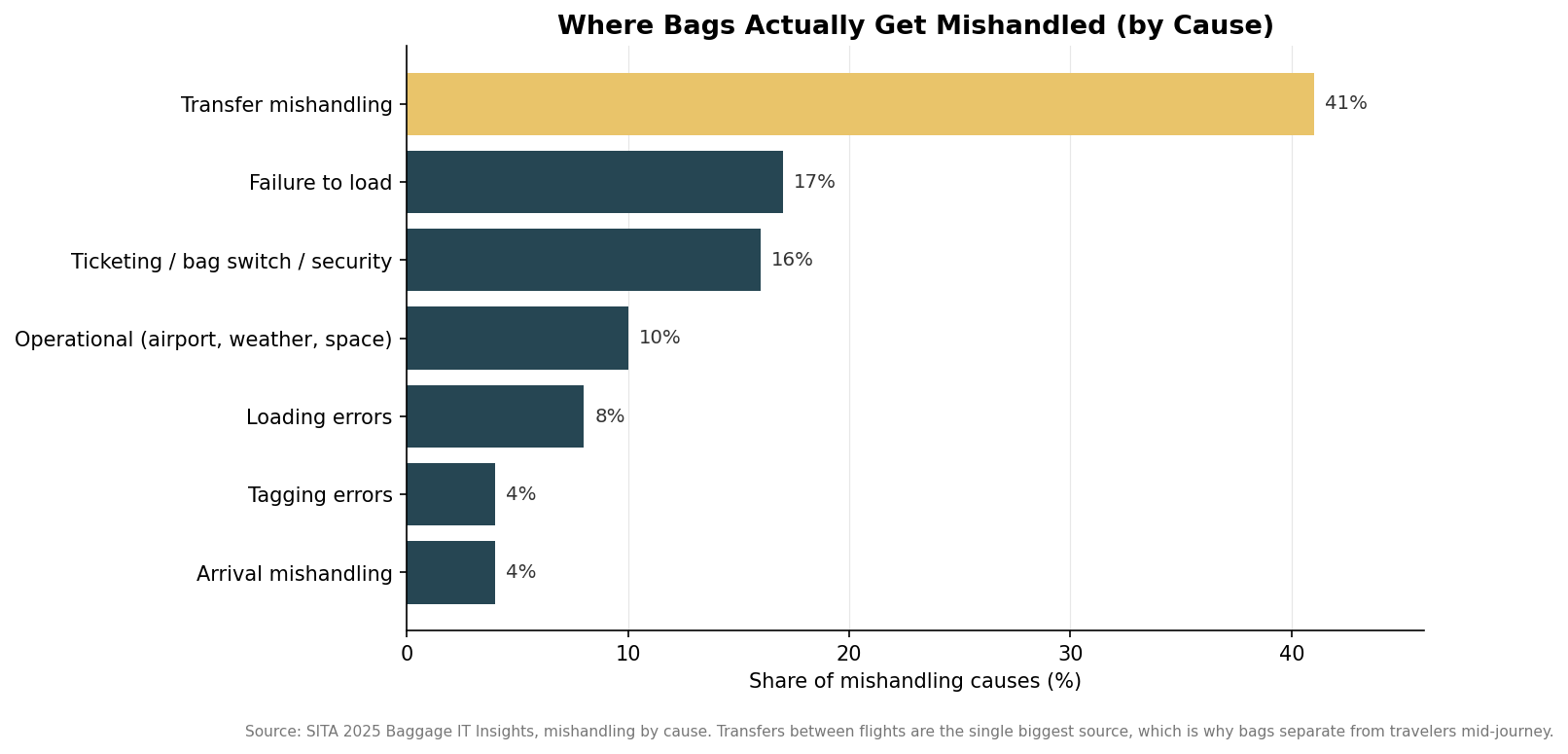
    Where bags actually go wrong tells you how to design the tag. The single largest cause of mishandling is transfers between flights, which alone accounts for around 41 percent of cases, followed by bags that fail to load and a cluster of ticketing and tagging errors.
    Horizontal bar chart of baggage mishandling causes, with transfers the largest at 41 percent
    Transfers between flights are the biggest cause of mishandling, at about 41 percent.

    The practical meaning is that your bag most often separates from you in the middle of a journey, in a connecting airport where the staff handling it may not share your language and are working from whatever is legible on the tag. That argues for international phone formatting, for an email as a language-neutral backup, and against clever layouts where the contact details are decorative rather than obvious. It also argues for a second identical tag or an ID card inside the bag, because outside tags do get torn off on the belt, and the inside label is what the airline finds when they open an unclaimed bag to identify it.

    Make it survive the belt

    Leather earns its place here because it takes abuse better than paper inserts and flimsy plastic sleeves, but the marking method still matters. A debossed or embossed impression, or a laser-etched mark, is part of the leather itself and stays readable after months of scuffing, whereas a printed paper insert behind a window fades, smears, and slides out. If you use a window-and-card tag, treat the card as replaceable and check it before each trip. On the privacy question of covered versus open tags, a flap or covered design hides your details from a casual glance in the terminal while still being readable when a handler lifts it, which is a reasonable middle ground; an open tag is faster to read but exposes everything all the time. Whichever you choose, write the details in permanent ink or, better, have them marked into the leather, and make sure the strap and its fastener are strong enough that the tag is still attached when the bag comes around the carousel. The best tag is the one that is still there, still legible, and still current when someone finally needs to read it.

    If you are ordering a batch

    Much of what gets bought is not a single tag but a run of them, for a team, an event, or a client gift, and the same principles scale with one addition. Decide up front whether every tag carries the same detail or whether each is personalized with an individual name, because variable personalization changes how the artwork is set up and can affect lead time. A common and privacy-safe approach for corporate gifts is to deboss the brand or a name on the front and leave the contact lines to the recipient, either on a replaceable insert card or in a space they can fill in themselves, so you are not printing anyone’s personal phone number across a whole order. Whatever you choose, order one physical proof and check the marking depth and legibility on the actual leather before committing to the full quantity, since a mark that looks sharp on screen can read faint once it is pressed into a textured hide.

  • Custom Leather Luggage Tags: Real Prices, MOQs & What to Order

    If you’re pricing out custom leather luggage tags for a wedding welcome bag, a corporate gift box, or a boutique retail line, the range you’ll find online is wide enough to be confusing — anywhere from about $2 a tag to nearly $8. That spread isn’t random. It comes down to three things: the grade of leather, the personalization method, and how many you’re ordering at once. Get those three variables straight before you request a quote and you’ll know immediately whether a price is fair.

    This guide walks through what suppliers actually charge, how minimum order quantities work, the real difference between full-grain, top-grain, and genuine leather, and how long you should expect production to take. Every figure below came from supplier pricing pages checked this month, so you can use them to sanity-check any quote you get.

    The short version: small orders (under 25 pieces) run $2–$7 per tag depending on leather grade and hardware, bulk orders of 200+ can drop under $5, and full-grain leather tags will outlast top-grain or genuine leather ones by a decade or more. Here’s the detail behind each of those numbers.

    Full-grain leather lifespan
    20+ years
    Top-grain leather lifespan
    5–10 years
    Genuine/bonded leather lifespan
    2–5 years

    Source: Durability Matters, "How Long Does Real Leather Last?", and RusticTown leather-care guides, retrieved August 2026

    What custom leather luggage tags actually cost

    Per-tag pricing for custom leather luggage tags depends heavily on which supplier you use and what’s bundled into the price — engraving, a snap or buckle closure, a matching ID card insert. At the low end, 4inLanyards prices its leather tags at $1.99 each with a 25-piece minimum. At the other end, LuggageTags.com’s leather tags with a magnetic closure start around $7.94, while its standard bulk leather style runs about $6.63 with a minimum of just 5 pieces. GS-JJ’s snap-closure executive leather tag lists between $5.27 and $8.78, though it’s frequently discounted to the $2.64–$4.39 range.

    None of these prices include setup or rush fees, which some suppliers add separately for engraving plates or expedited turnaround. If a quote looks unusually low, check whether engraving, hardware, and a keyring loop are actually included — some listings price the blank tag and treat personalization as an add-on.

    Per-tag price for a small custom order ranges from about $2 to $7 depending on supplier, leather type, and hardware.
    Supplier Price per tag Minimum order Material
    4inLanyards $1.99 25 tags Leather
    LuggageTags.com $6.63 5 tags Leather
    GS-JJ (Executive Snap style, on sale) $2.64–$4.39 Any qty ($99 order min) Leather
    Lifetime Creations $6.99 (12–24 tier) 12 tags Vegan leather
    Per-tag price for a small custom order ranges from about $2 to $7 depending on supplier, leather type, and hardware.Source: 4inLanyards.com, LuggageTags.com, GS-JJ.com, and LifetimeCreations.net product/pricing pages, retrieved August 2026

    Bulk pricing and minimum order quantities

    Minimum order quantities in this category are low compared to most promotional products — you won’t find yourself forced into a 500-piece order just to get a custom leather luggage tag made. Lifetime Creations’ vegan-leather tags start at a 12-piece minimum, 4inLanyards sets its minimum at 25, and LuggageTags.com will fill an order of just 5. That makes this a realistic category for a single wedding party, a small team gift, or a boutique test run before committing to a bigger batch.

    Where volume really pays off is in the per-unit price curve. Lifetime Creations publishes a clear tiered structure: $6.99 each for 12–24 tags, dropping to $6.41 at 25–99, $5.83 at 100–199, $5.25 at 200–499, and $4.59 at 500 or more. That’s a 34% reduction in per-tag cost just from scaling a 12-piece order up to 500 — worth knowing if you’re deciding between ordering exactly what you need now versus padding the order for a future batch of gifts.

    Per-tag price for engraved vegan-leather luggage tags drops from $6.99 to $4.59 as order size grows from a dozen to 500+ units.12–24: $6.99; 25–99: $6.41; 100–199: $5.83; 200–499: $5.25; 500+: $4.5912–24$6.9925–99$6.41100–199$5.83200–499$5.25500+$4.59
    Per-tag price for engraved vegan-leather luggage tags drops from $6.99 to $4.59 as order size grows from a dozen to 500+ units.Source: Lifetime Creations, lifetimecreations.net (bulk custom luggage tags pricing), retrieved August 2026

    Full-grain vs. top-grain vs. genuine leather

    The word “leather” on a product listing doesn’t tell you much on its own — the grade matters more than almost anything else in this purchase. Full-grain leather uses the entire top layer of the hide, including its natural texture, and is not sanded or corrected in any way. It’s the most durable option and the only one that develops a genuine patina with use. Top-grain leather has that outer layer sanded away and refinished with a coating, which makes it thinner, more uniform in color, and usually cheaper — but once that surface coating cracks, the leather underneath degrades faster. Genuine leather, despite the reassuring name, is typically the bonded scraps left over after the better grades are cut away, with an embossed fake grain pressed on top; it’s the least durable and least expensive option.

    For a luggage tag specifically — something that gets clipped to a bag handle, thrown into overhead bins, and rained on at a curbside check-in — durability matters more than it would on a wallet that lives in a pocket. If the tag is a one-time event favor, genuine or vegan leather is a reasonable, budget-friendly choice. If it’s meant to survive years of actual travel, full-grain is worth the higher price per tag.

    Personalization: engraving, debossing, and foil stamping

    Laser engraving is the most common way to personalize a leather luggage tag, and it’s what most suppliers default to for bulk and corporate orders. It burns the design into the surface, and on tan, brown, or gray leather it typically engraves as a dark, high-contrast mark — good for logos, small text, and names that need to stay legible from a few feet away. Debossing presses a design into the leather rather than burning it; done without color, it’s called blind debossing and reads as a subtle, tone-on-tone mark. Add foil to that same debossed impression — gold or silver is most common — and you get a more formal, retail-grade finish, usually at a higher per-unit cost than plain engraving.

    If you’re ordering for a wedding or a retail product line where the tag itself is part of the presentation, foil-stamped debossing tends to look more considered. For corporate gifting or event badges where legibility and cost per unit matter more than finish, laser engraving is the more practical default.

    Lead times and rush options

    Standard production for custom leather luggage tags generally falls in the two-to-three-week range from art approval to ship date, though a few suppliers publish longer windows — up to 15 business days at the fast end and, for some heavily backed-up shops, closer to 26–30 business days during peak seasons. If you’re ordering for a wedding or a fixed event date, build in that full window plus shipping, and confirm the ship date in writing rather than assuming “in stock” language applies to a personalized item.

    Rush production is widely available across suppliers in this category, typically compressing the timeline to 1–3 business days of production before shipping, usually for an added fee. If your event is inside three weeks out, ask specifically about rush pricing before you place the order — it’s almost always cheaper to pay the rush fee upfront than to expedite shipping later on a tag that missed standard production.

    What to decide before you request a quote

    Before you contact a supplier, nail down four things: leather grade (full-grain if it needs to last, genuine or vegan if it’s a one-time favor), personalization method (engraving for legibility and cost, foil debossing for a more finished look), hardware (a simple loop strap is cheapest; snap or magnetic closures with a windowed ID insert cost more but protect the address card from weather), and quantity, since even a jump from a 20-piece to a 100-piece order can meaningfully lower your per-tag cost.

    It’s also worth asking any supplier directly whether their “leather” is genuine animal hide or a vegan/PU alternative — “leatherette” and “vegan leather” show up interchangeably in listings, and the difference affects both price and longevity even though both can look identical in a product photo.

    Frequently asked questions

    What's a reasonable price for custom leather luggage tags?

    For small orders (5–25 pieces), expect roughly $2–$7 per tag depending on leather grade and hardware. Simple engraved leather-look tags from suppliers like 4inLanyards start near $2 each at a 25-piece minimum, while genuine or vegan leather tags with a snap or magnetic closure run $5–$8. Bulk orders of 200+ can bring the per-tag price under $5.

    What is the minimum order quantity for custom leather luggage tags?

    Minimums are low across the category. LuggageTags.com will fill orders as small as 5 pieces, Lifetime Creations starts at 12, and 4inLanyards sets its minimum at 25. There’s no need to order in the hundreds unless volume pricing makes sense for your use case.

    Is full-grain leather worth the extra cost for a luggage tag?

    If the tag needs to survive years of actual travel handling, yes — full-grain leather typically lasts 20 or more years with basic care, versus 5–10 years for top-grain and as little as 2–5 years for genuine or bonded leather. For a one-time event favor or gift, a lower grade is a reasonable way to cut cost.

    How long does it take to get custom leather luggage tags made?

    Standard production is typically two to three weeks from art approval to ship date, though some suppliers list up to 15 business days at the fast end. Rush service, where offered, can cut production to 1–3 business days for an added fee — worth asking about if you’re ordering inside three weeks of an event.

    Should I choose laser engraving or foil stamping for personalization?

    Laser engraving is cheaper and gives strong contrast on tan, brown, or gray leather — a good default for names, logos, or short text. Foil-stamped debossing costs more per tag but gives a more formal, retail-quality finish, which is worth it for weddings or a product line where presentation matters as much as legibility.

    What's the difference between "genuine leather" and "vegan leather" tags?

    Genuine leather is real animal hide, just the lowest grade of it — bonded scraps with an embossed fake grain, prone to cracking within a few years. Vegan or PU leather is a synthetic alternative that can look nearly identical in photos but has different wear characteristics; always ask a supplier which one you’re actually getting, since listings use the terms loosely.

    The bottom line

    The fastest way to avoid overpaying — or underbuying — on custom leather luggage tags is to fix your leather grade, personalization method, hardware, and quantity before you request pricing. A 25-piece order of engraved genuine-leather tags with a simple strap and a 100-piece order of foil-debossed full-grain tags with a magnetic closure are different products at different price points, even though both get listed under the same search term. Use the numbers above as a baseline, confirm production time in writing against your event date, and ask every supplier directly whether “leather” means real hide or a vegan alternative before you place the order.

  • Why Luggage Tags Outperform Most Corporate Gifts

    Call or Text us: (929) 605-4397
    Business

    Why Luggage Tags Outperform Most Corporate Gifts

    The audience selects itself

    Most corporate gifts are used once and stored. A luggage tag is carried in public by the exact audience most brands are trying to reach, for years, at a low unit cost.

    It is seen by strangers, not just the recipient

    This is the part that separates a tag from a branded pen. The pen is seen by one person at a desk. The tag circles a carousel in front of a few hundred travellers on every single trip, most of them business travellers.

    Utility is what keeps it in service

    Gifts survive when they solve a problem. A tag with a privacy flap and a buckle strap is genuinely better than what most people currently have on their bag, so it replaces it rather than joining a drawer of promotional items.

    Personalisation changes the response

    A laser-engraved name turns a branded item into that person’s item. It costs nothing extra in tooling and it is the difference between a gift that is kept and one that is regifted — worth doing for any list you actually care about.

    Specify it to last

    Full-grain hide, a privacy flap, and a leather strap with a metal buckle. Send your logo and your name list if you have one, and we will lay it out on your mockup. Minimum order is 12 tags, production runs 2 weeks, and your free mockup arrives within 24 hours.

    Create your custom leather luggage tags now.

    Send your logo, quantity and date — you’ll get a free mockup and quote within one business day.

    Get a Quote
    GET A QUOTE
  • Deboss, Foil or Laser: Which Marking Method Do You Need?

    Call or Text us: (929) 605-4397
    Specs

    Deboss, Foil or Laser: Which Marking Method Do You Need?

    Three methods, three different jobs

    All three put your mark permanently into leather, and they are not interchangeable. The right one depends on distance, colour and whether every tag is the same.

    Blind deboss: understated and permanent

    A heated brass die presses the shape into the hide. No ink, no film, nothing to wear off, and the impression darkens with handling. It is the most tactile option and the most restrained — which also means it does not read from more than a metre away.

    Foil: the same press, with light in it

    Foil stamping lays metallic leaf into that same pressed impression. Because the foil sits down inside the recess rather than on the surface, handling does not rub it away. On dark hides it is often the only way to make a mark legible at all.

    Laser: when every tag is different

    A die is cut once and repeats one image. A laser draws each tag individually, so personalising two hundred tags with two hundred names costs nothing extra in tooling. It also resolves much finer detail, which is why QR codes have to be lasered.

    How to choose

    Blind deboss for restrained corporate gifts, foil when it must read across a room or sit on dark leather, laser for names, numbers and codes. Minimum order is 12 tags, production runs 2 weeks, and the mockup is free within 24 hours.

    Create your custom leather luggage tags now.

    Send your logo, quantity and date — you’ll get a free mockup and quote within one business day.

    Get a Quote
    GET A QUOTE
  • Custom Leather Luggage Tags: A Buyer’s Guide

    Call or Text us: (929) 605-4397
    Buyer’s guide

    Custom Leather Luggage Tags: A Buyer’s Guide

    A gift that travels is a gift that gets seen

    A luggage tag is one of the few corporate gifts that gets used in public, repeatedly, for years. It is also one of the easiest to get wrong in ways that only show up after the first flight.

    Three decisions matter: the grade of the leather, whether the details are covered, and how the tag attaches. Get those right and the tag outlasts the relationship. Get them wrong and it is in a bin by the second trip.

    The attachment is what actually fails

    Ask anyone who has lost a tag and it was not the leather that gave up. Thin plastic loops catch on baggage belt rollers and snap, and the tag disappears into the system. A leather strap with a metal buckle survives that, and it fits thick handles a fixed loop will not go round.

    Open windows are a genuine security problem

    An uncovered card broadcasts a home address to everyone at the carousel and to anyone photographing the belt. A privacy flap costs almost nothing and removes the issue entirely. Airline staff can still lift it in a second when they need to.

    Full-grain is the only grade worth specifying

    Tags get crushed, dragged and thrown. That treatment gives full-grain hide its patina and cracks bonded leather at the fold within a year. “Genuine leather” is a low grade despite the name, and on an item handled this hard the difference shows fast.

    What to expect when you order

    Send your logo and tell us whether the tags need individual names. You will get a free mockup within 24 hours, unlimited free revisions, and you pay nothing until you approve it. Minimum order is 12 tags and production runs 2 weeks, with faster turnaround available on express shipping.

    Create your custom leather luggage tags now.

    Send your logo, quantity and date — you’ll get a free mockup and quote within one business day.

    Get a Quote
    GET A QUOTE